What Are Closing Costs and How Much Will You Pay?
This list goes through most every cost you may face.


Written by May Ortega on June 25, 2026
Reviewed by Neil Swanson and Kara Ng, Edited by Jessica Rapp
Budgeting for a home purchase is more than just accounting for your down payment. As a buyer, you’ll also be responsible for a range of fees that cover services and ensure a smooth transaction. Some fees are related to the property itself, while others are required to close and fund your loan.
Note, that if you’re selling, most of your closing costs are related to real estate agent commissions, though the buyer may ask you to cover some of their closing costs as part of the negotiation.
What are closing costs?
Closing costs are fees associated with your home purchase. Some are paid to your lender, and others to third parties such as appraiser, inspector and title company in order to finalize and fund your loan. There are various types of closing costs, with most being paid by the buyer, but some being paid by the seller.
How much are closing costs?
Buyer closing costs are usually between 2% to 5% of the home’s purchase price. For example, if the home costs $300,000, you might pay between $6,000 and $15,000 in closing costs.
Seller closing costs have historically ranged from 8% to 10% of the sale price of the home, but this can vary widely based on agent commissions, taxes and more. The seller's closing costs are deducted from the proceeds of the sale of the home at closing, so you rarely need to bring cash to closing.
A lot of factors impact how much you’ll pay in closing costs. For buyers, those variables include the mortgage loan program and individual lender practices. For sellers, it mainly comes down to what you’ve negotiated in terms of agent commission, concessions and any taxes. Estimate your closing costs with Zillow's Closing Cost Calculator.
Who pays closing costs — the buyer or the seller?
Both buyers and sellers pay closing costs. Buyers pay more individual costs than the seller, but the seller often pays a higher dollar amount because they're covering the real estate agent commissions.
When are closing costs due?
Most closing costs are due on the day of closing, when the property is transferred from the seller to the buyer. Money is typically wired to the receiving parties upon closing, or the buyer will bring a cashier’s check to the closing appointment.
However, there are some closing costs paid before closing day, including inspection and appraisal fees. Home inspections are usually completed within a week of your offer being accepted and are paid for at the time of service.
If you are getting a flood zone certification or land survey, you’ll also pay for these at the time of service, though sometimes the cost is shared with the seller.
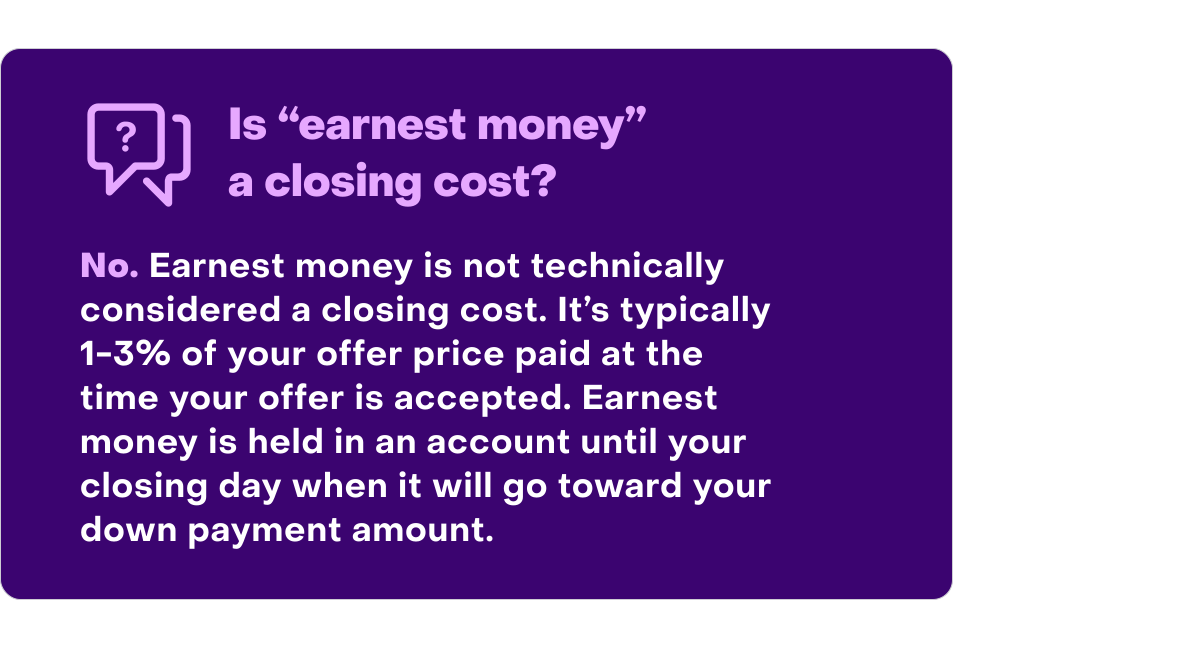
Note: Earnest money is not technically considered a closing cost (nor does it factor into a buyer’s 2% to 5% range), but it plays an important role in your total payment on closing day. It’s typical to make an earnest money deposit when you put an offer in on a home. The average amount ranges between 1% to 3% of the offer price. It’s deposited into a third-party account to show the seller that you’re a serious buyer. It’s held there until closing day, when it is applied to your down payment amount.
Closing costs for buyers
Buyer closing costs are a combination of one-time fees and the initial installments of recurring costs you’ll pay alongside your mortgage every month. An example of a recurring cost is your homeowners insurance premium. You’ll likely pay your first year’s premium at closing. In future years, it will be paid either out of pocket or via an escrow account you add funds to every month.
Note that every lender and closing agent bundles closing costs differently. For example, yours may bundle fees like recording fees, courier fees and notary fees into one line item called "administrative fees."
Here’s a quick breakdown of homebuyer closing costs:
One-time fees
- Credit report and credit supplement fees
- Loan application fee
- Home inspection fee
- Appraisal fee
- Land or property survey fee (optional)
- Mortgage origination fee
- Document preparation fee
- Processing or underwriting fee
- Title search fee
- Lender’s title insurance (plus optional owner’s title insurance)
- Closing, escrow or settlement fee, paid to attorney or settlement agent
- Bank processing fee
- Courier or wire fee
- Notary fee
- Recording fees for deed and loan
- Flood certification or determination fee
- Prepaid costs (per diem interest, homeowners insurance premium, property taxes and mortgage insurance if applicable)
- Discount points (optional)
- HOA transfer fees if applicable
Recurring fees
- Homeowners insurance premiums
- Property taxes
- Mortgage insurance premiums (for buyers making a down payment of less than 20%)
What are the closing costs for cash buyers?
Unlike a buyer using financing, cash buyers won’t have to pay any mortgage-related fees. However, many cash buyers still opt to pay for an inspection, appraisal and owner's title insurance.
Closing costs for sellers
Sellers usually pay buyer and listing real estate agent commissions; their own attorney or settlement costs; and transfer taxes if applicable. There may be other smaller fees, as well.
Here’s a list of the most common closing costs for sellers:
- Real estate agent commissions
- Closing, escrow or settlement fee, paid to attorney or settlement agent
- Transfer taxes if applicable
- Prorated property taxes, utilities and HOA fees as applicable
- Credits toward closing costs if applicable
How to estimate closing costs
The best way to estimate your closing costs is to review the Loan Estimate provided to you by your lender during the loan application process.
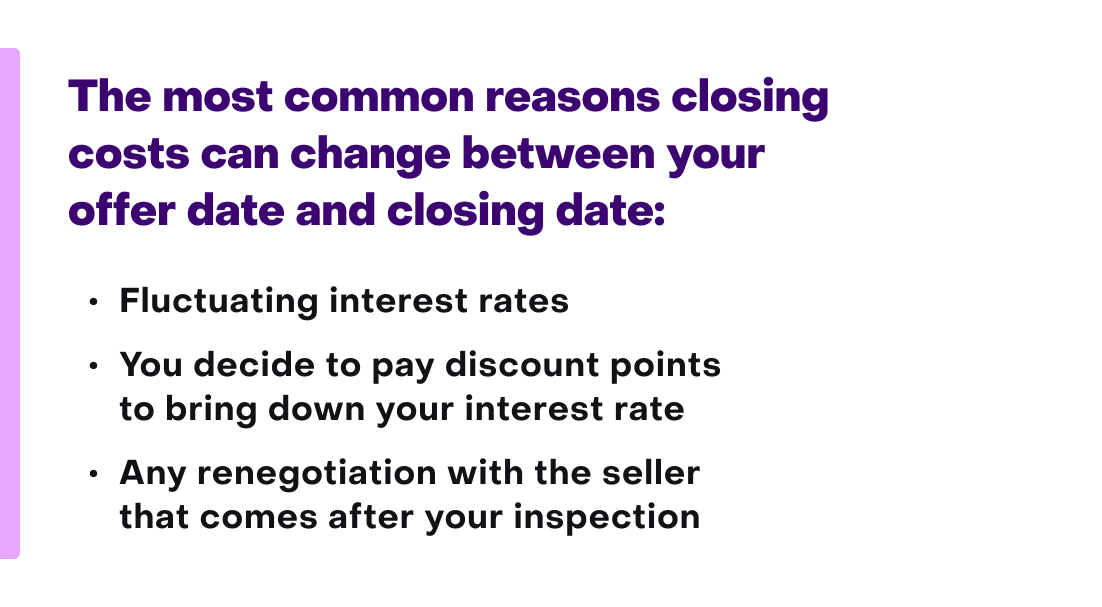
Keep in mind: Individual line items may change during the course of the transaction, up until your closing date, since many of the figures on the Loan Estimate are simply that: estimates. If you didn't lock your rate, your rate may change from the initial quote — or, if you decide to pay discount points, it'll change to the lower rate. You're also permitted to shop around for some services, so you may find a lower-cost provider than the estimate. Of course, costs can also change if the seller decides to give credits to the buyer to compensate for issues with the home.
At least three business days before closing, you’ll receive a Closing Disclosure from your lender. Be sure to compare this final statement with your Loan Estimate, and ask your lender to explain any costs that have changed. There are limits to the amount that fees can increase between the time you receive your Loan Estimate and your Closing Disclosure, so there should not be any surprises.
How to avoid closing costs
There's no way to avoid closing costs, whether you’re buying, selling or refinancing. You may be able to roll closing costs into your loan instead of paying them on closing day, but you'll pay more interest when you finance them that way. (This is often known as a "no-closing cost loan," but you aren't really avoiding the costs.)
However, there are a few things you can do upfront to minimize how much you pay:
Compare and negotiate lender fees
Shop around for mortgage lenders with low or no fees — that usually means they charge a low origination fee, no origination fee at all or waive costs like the application fee. Be sure to compare the interest rates for low- or no-fee lenders with lenders that charge fees, because sometimes, the no-fee lenders charge higher rates to compensate for the lack of fees. Ask the lender for a breakdown of all the fees including the APR (annual percentage rate) of the loan.
If you find a lender you like but they charge fees, you can ask to reduce or waive them, too. It may help to have the costs from other lenders as leverage. Some lenders will even match a competing lender's offer.
Ask the seller to contribute
As a buyer, you can request that the seller pay for some or all of your closing costs while negotiating the offer. Buyers say that the sellers agreed to pay some (23%) or all (44%) of their closing costs in the final offer they accepted, according to the Zillow Consumer Housing Trends Report 2025.
Keep in mind that lenders must adhere to regulations that dictate which closing costs sellers can cover for buyers, and the amount sellers can contribute. Be sure to ask your lender about the specifics of your loan program.
Apply for assistance
It can be challenging for first-time home buyers to have enough cash to cover both the down payment and closing costs, since you won’t have the proceeds from a previous home sale to use. Check if you're eligible for a down payment or closing cost assistance program, typically a lower-cost mortgage paired with additional funds for those purposes.
Mortgage-related closing costs
Many of the closing costs you’ll pay as a buyer are related to the creation of your mortgage. Here’s a summary of those costs by loan type:
Closing costs on a conventional loan
Conventional loan closing costs typically range between 2% and 5% of the purchase price. If you make a down payment of less than 20%, you’ll pay private mortgage insurance (PMI) until you reach a loan-to-value ratio (LTV) of 78%, when you can request cancellation of the payments.
There are limits to how much of the buyer’s closing costs the seller can cover. If you make a down payment of 25% of the purchase price or more, the seller can pay for closing costs up to 9% of the total loan amount. If your down payment is between 10% and 24%, they can cover up to 6% of closing costs. For down payments of less than 10%, the seller can assist with closing costs up to a total of 3% of the loan amount.
Closing costs on an FHA loan
You can expect to pay between 2% and 6% of the home sale price in FHA loan closing costs. This includes an upfront mortgage insurance premium (UFMIP) paid at closing. (You’ll also make a monthly MIP payment throughout the life of your loan or for 11 years, depending on the amount of your down payment, or, until you refinance to a conventional loan with at least 20% equity.)
With an FHA loan, there are limits on how much of your closing costs the seller can pay on your behalf. It can’t exceed 6% of either the appraised value or the purchase price, whichever is lower.
Closing costs on a VA loan
VA loan closing costs usually range between 1% and 5% of the total loan amount. The wide range can be attributed to the VA funding fee, which varies from 0.5% to 3.3% of the loan amount. The exact fee depends on whether you're buying or refinancing, the size of your down payment and whether you've used VA loan benefits in the past.
There are limits to seller concessions for VA loans, too. As the buyer, you can’t have the seller pay more than 4% of the total loan amount in closing costs. Sellers are also not allowed to pay for discount points.
Closing costs on a USDA loan
USDA loan closing costs are often 3% to 6% of the total loan amount. This includes an upfront guarantee fee of 1% of the loan. (There are also annual guarantee fees, paid after closing.) The amount a seller can cover in buyer closing costs is capped at 6% of the home sale price.
What’s included in closing costs?
When you get your Loan Estimate, it can be a little overwhelming — the list of individual line items seems to stretch on and on. Here’s a list of the most common closing costs in alphabetical order, including the general amount of the charge and purpose for the cost:
Application fee
The application fee covers the cost for the mortgage lender to process your mortgage application. Not all lenders charge an application fee. If yours does, you may be able to get it discounted or waived if you ask.
Appraisal fee
Lenders require a home appraisal as part of the underwriting process to determine the fair market value of the home. The buyer typically pays the appraiser's fee at the time of the visit or before it's scheduled. The cost of an appraisal is roughly $300 to $450, but the price varies by location and size of the property.
Attorney's fee
In many states, a closing, escrow settlement attorney oversees the process of closing the real estate transaction, including collecting and disbursing funds. The attorney's fees are typically split between the buyer and seller, and usually range between $500 to $1,500 or more.
A closing attorney is required for some or all aspects of the closing process in 22 states and Washington, D.C. These states are Alabama, Connecticut, Delaware, Georgia, Kansas, Kentucky, Maine, Maryland, Massachusetts, Mississippi, New Hampshire, New Jersey, New York, North Carolina, North Dakota, Pennsylvania, Rhode Island, South Carolina, Vermont, Virginia, West Virginia and Wyoming. Keep in mind that in some of these states, the requirement may only apply to certain counties or areas.
In states that don't require an attorney, an escrow or settlement agent or company handles the transaction.
Along with a closing attorney, you can also opt to pay a separate real estate attorney to advise you in terms of the purchase agreement. This is often an hourly rate based on location, the attorney's experience and services they provide.
Credit report fee
Lenders charge a fee to pull your credit reports from the three credit bureaus. This fee ranges from $30 to $50 or more.
Credit supplement fee
Lenders may charge you a credit supplement fee, paid to the credit bureaus, to verify that the information in your credit reports is up to date. This isn't a common practice, but if the initial credit pull happened a while ago, it may be necessary for the lender to do. The credit supplement fee is about $15 for each item that requires verification, so your cost can range from $15 to $100 or more.
Discount points
You can buy down the interest rate on your mortgage by paying “points” — essentially, paying interest in advance. One point is equal to 1% of the loan amount and typically reduces your rate by 0.25%. Not all buyers choose to buy down their interest rate, but if you do, you’ll pay for it at closing.
Documentation fees
During a financed home purchase, several institutions need to process information and create official records.
- Bank processing fee: Your lender may charge you a fee to cover the bank's processing costs, between $25 and $100.
- Courier or wire fee: Your attorney or settlement agent can charge fees to cover the delivery of documents and funds to various parties in the transaction. One courier trip typically costs $20, and wire fees can cost anywhere from $25 to $35.
- Document preparation fee: Your lender may charge this fee to cover some administrative costs, often up to a few hundred dollars.
- Notary fee: Notaries charge by the signature, often about $100 for closing paperwork. They may add fees for far-away travel.
- Recording fees: Your lender charges fees to record both the deed to the property and the mortgage with your local recording office, usually the town clerk. These are separate fees that together can cost anywhere from $100 to $200.
Escrow fee
If the transaction doesn't involve an attorney, the buyer and seller pay an escrow fee to the escrow or settlement company conducting the closing. This fee is often split between the parties, and typically runs 1% to 2% of the home's sale price.
FHA upfront mortgage insurance premium (UFMIP)
If you’re using an FHA loan to purchase the home, you’ll be required to pay a premium at closing that totals 1.75% of the loan amount. You can also roll this into your loan if you’d prefer, but note that you would pay interest on the premium amount.
Flood zone certification or determination fee
This fee is charged by your lender and paid to a third-party company to determines if the property is located in a flood zone. If it is determined that the property is in a flood zone, you'll need to buy a flood insurance policy separate from your homeowners insurance policy.
Home inspection fee
Although it's not required by lenders, a home inspection is a common contingency in real estate transactions. Soon after the seller accepts your offer, you'll pay an inspector to evaluate the condition of the home and its systems. The inspection fee costs anywhere from $250 to $700 depending on the size of the property and whether you want inspections above and beyond what's standard, such as a pool or septic tank inspection. You'll pay the inspector out of pocket at the time of service, not at closing.
HOA transfer fee
When you buy a property that is managed by a homeowners association (HOA), there's typically a transfer fee that covers changing the property owner on documents, providing keys and access and other administrative tasks. The buyer and seller can negotiate who will pay this fee, which generally runs about $200.
Note: At closing, you may also be required to make your first HOA dues payment, prorated based on your closing date.
Lender’s title insurance policy
Title insurance is an insurance policy that protects the lender in the event of issues with the home's title, such as an unresolved lien. Although this insurance protects the lender, the buyer pays for it in a one-time fee at closing. The fee typically costs up to 1% of the home's purchase price.
Origination fee
The mortgage origination fee covers the lender’s costs to originate, or create, your loan. It’s usually 1% of the total loan amount, but if you shop around, you may be able to find lower fees. Some lenders don't charge an origination fee, but they may raise their interest rates to make up for it.
Owner’s title insurance policy
If you're buying the home, you can choose to pay for an additional title insurance policy, known as an owner's policy, that protects you from future claims against the title. Similar to the required lender's policy, you can expect to pay up to 1% of the home's price for an owner's policy.
Per diem interest
Because you’ll likely take ownership of your home on a date that’s not the first of the month, you'll be responsible for prepaying interest that accrues for your mortgage between the closing date and your first mortgage payment. Your lender will calculate this cost, known as per diem interest, using the daily interest rate multiplied by the number of days.
Prepaid costs
If the lender requires the buyer to pay homeowners insurance premiums and property taxes through an escrow account, the buyer has to prepay these costs prior to closing to ensure the account is funded.
Homeowners insurance premiums vary widely based on location and the amount of coverage, but often, you'll be required to pay one year's worth of coverage for escrow. For prepaid property taxes, you may be end up splitting the cost with the seller on a prorated basis.
Note: If you're buying with a conventional loan and make a down payment of less than 20%, your lender will require you to pay private mortgage insurance, or PMI. This premium may be included in your prepaid costs, as well.
Survey fee
You can choose to have a land or property survey before closing. If so, you'll pay out of pocket for a surveyor to come out and confirm the property lines. Usually, a survey costs around $500, with larger lots costing more.
Title search fee
Along with title insurance, you’ll pay a title search fee to the title company in exchange for conducting a thorough search of a property’s records. This ensures that no one else has a claim to the property you’re buying. The cost can run anywhere from $100 to $400.
Transfer taxes
A transfer tax is a one-time tax imposed by a state, county or local government whenever a property changes hands. It may be a flat fee or a percentage of the home price, and the cost can vary significantly by location. Not every state levies transfer taxes.
Underwriting fee
Some lenders charge an underwriting fee, also known as a processing fee, which covers the cost of verifying your credit and financial information and making a determination about approving or denying your loan. Sometimes, this fee is included in the origination fee. If it's charged separately, it can range between $400 and $900.
USDA upfront guarantee fee
USDA loans require the buyer to pay guarantee fees. That includes an upfront fee of 1% of the loan amount, paid at closing or rolled into the loan. (Most buyers roll it in.)
VA funding fee
If you’re using a VA loan to buy your home, you’ll pay a VA funding fee. It can cost between 0.5% and 3.3% of the loan amount, depending on the size of the down payment, whether you're buying or refinancing and whether you've used a VA loan in the past. It can be paid at closing or rolled into your loan and paid over time (with interest).
How much home can you afford?
At Zillow Home Loans, we can pre-qualify you in as little as 5 minutes, with no impact to your credit score.
Zillow Home Loans, NMLS # 10287. Equal Housing Lender
Get pre-qualifiedHow much home can you afford?
See what's in reach with low down payment options, no hidden fees and step-by-step guidance from us at
Zillow Home Loans.

Zillow Home Loans, NMLS # 10287. Equal Housing Lender
Calculate your BuyAbility℠

Related Articles


Thinking about buying but not sure where to begin?
Start with our affordability calculator.
See what you can afford